Comments from October 2, 2026.
From record-high diesel prices, largely caused by the US-Iran war, to a notable cooling of interest in export lumber, Southern hardwood market participants are dealing with a number of major challenges right now. Low log supply is starting to emerge as the latest.
While several larger operations are confident that they will remain well supplied through fall and winter, several contacts at green sawmills from Arkansas to the Carolinas are concerned they could run out of logs to cut later this year or early next. Regardless of the sector, the flow-on effects of reduced log supply are obvious.
“I have a re-occurring conversation at the moment, the lack of logs,” one Southern sawmill operator told HMR/Fastmarkets. “I don’t think it’s limited to one area, it’s scattered. Most everyone doesn’t have log inventory going into the winter.”
“We’ve had really great logging weather over the last few weeks and have been getting very little,” an Arkansas source said. “I feel good about one track we have lined up, but, otherwise, I’d say we’d be 50/50 on running out of logs this winter.”
ASH: The market for Southern Ash, both green and kiln dried, remains well-balanced. Both domestic and international interest in the species is relatively cool, though observed prices reveal a recent bump in demand for green 5/4 stock. As a result, green 5/4 #2A&Btr listings increase this week. The listing for green 4/4 #2A also rises. There are no changes for kiln dried listings and ranges.
SOFT MAPLE: Soft Maple is not a heavily sawn species in the Southern region, with limited demand from area concentration yards. Despite this, reported prices show there is increased interest in higher-grade Soft Maple at the moment. In this edition of HMR, all listings for green #1C&Btr in 4/4 and 5/4 are increased.
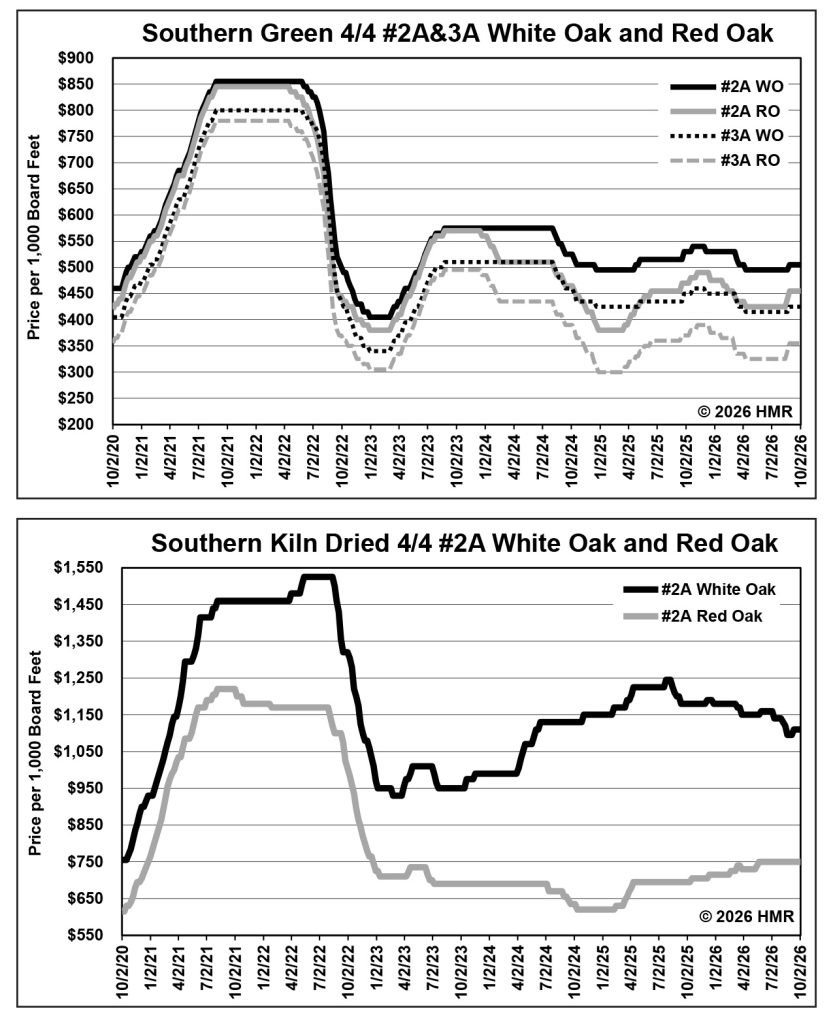
#2A&3A OAK: Truck trailer flooring plants are continuing to buy in healthy numbers in the Southern region, providing an avenue for those cutting 5/4 #2A&3A Oak. That said, contacts say production is sufficient to meet demand, resulting in stable pricing for #2A&3A. Purchasing for residential flooring plants is known to be steady too, but is occurring at a rate met by current supply from green sawmills.
RED OAK: The market for Southern Red Oak remains cool. While they are able to comfortably move stock, contacts don’t talk about the species with a great deal of excitement at the moment. On the green side, the only change to a listing is a small bump for 4/4 #1C. Though international interest in kiln dried Red Oak is down across all three hardwood-producing regions, reported prices only lead to decreases for the listings and lower ends of the ranges for 4/4 Fas.
WHITE OAK: Reduced international demand is playing an even bigger role in the fate of White Oak in the South, with observed business leading to a number of listing decreases for kiln dried stock this week. The listings and ranges all fall for 4/4 #1C, 5/4 #1C, and 5/4 #2A, while the lower ends of the ranges for 4/4 #2A also drop. Some contacts have been encouraged by sales of upper-grade dry stock, though this is not being felt across the board. Domestic interest is steady, ensuring the listings for green lumber remain unchanged.
POPLAR: Though contacts say Vietnamese clients are still buying, cooling Chinese interest in Poplar is continuing to be felt by Southern sawmills. Reported prices for kiln dried stock bear this out. There are decreases to the listings and ranges for 4/4 Fas and 4/4 #2A. The listings for 4/4 #1C also drop for a second straight week. The market for green Poplar in the South is balanced, leading to no changes to listings.
BOARD ROAD, FRAMESTOCK, CANTS & TIES: The industrial sector remains relatively strong in the South with particularly good business being reported in the mat timber market. Several major long-term oil projects in Texas are understood to be driving this, though, unlike September, there is no movement in the listing or range numbers for board road this week. Reported prices for framestock are also well covered by existing published ranges.
Crosstie quotas continue to loosen across the region with tie treaters ramping up purchasing as the cooler months begin. Despite this, there are no changes in tie ranges on either side of the Mississippi River in this edition. The Southern hardwood cant market remains sluggish compared with other regions, though observed business did lead to an increase in the upper end of the range.