
Comments
Comments from November 20, 2026.
Log availability is still the biggest talking point when it comes to conversations with Southern hardwood market participants. While it is not uniform across the region—sawmills in Mississippi and Arkansas are better off than most—even those with decent log piles are expressing concern for those running low.
Despite recent diesel price drops, the cost of putting lumber on the back of a truck remains a major issue for those running Southern sawmills, along with inflated prices for equipment. “Inflation is real,” one Southern sawmill operator told HMR/Fastmarkets. “The impact of diesel has been very real. Another thing is you worry about equipment going down. Everything is so expensive right now.”
ASH: Even though it’s been colder, weather across the Southern region has been conducive for logging of lowland species like Ash recently. Despite this, contacts say Ash is rivaling Red Oak as the hardwood species hardest to procure at the moment. There are no changes to any green Ash prices this week. The only alteration to the kiln dried price matrix is an increase to the listings for kiln dried 4/4 #1C. This upward movement comes due to a slight bump in export interest.
#2A&3A OAK: After four straight weeks of increases to green Red Oak #2A&3A, prices have stabilized in this edition. There is plenty of activity in the market for flooring-grade Red Oak with buyers for Appalachian residential and area truck trailer flooring plants, both purchasing in decent numbers at the moment. The shortage of Red Oak logs has also played its part in these price increases. There are no changes to the #2A&3A White Oak prices, with observed prices showing the clear majority of business being done around HMR’s published figures.
SOFT MAPLE: Soft Maple has limited uses in the Southern region, meaning even a small downturn in demand will make itself quickly felt observed business. As such, reported prices of Wormy Soft Maple lead to the listings for green #2B, across all thicknesses, falling this week.
RED OAK: Red Oak remains the species contacts describe as the most impacted by the current log availability squeeze. Yet despite constricted supply, green prices stayed stable in observed business. The only green price change is an upward bump to the listings for 5/4 Fas&1f. On the dry side, the sluggish international picture contributes to a fall in the listings and both sides of the ranges for 4/4 Fas. There are no other changes to kiln dried listings or ranges.
WHITE OAK: Contacts report growing interest in White Oak uppers over the last week, with availability of species’ logs not seen as a major problem across the region. Prices for green 4/4 Fas&1f have trended downwards in 2026, with this week’s published price sitting $255 per thousand board feet ($/MBF) lower than a year ago. The last time the green 4/4 Fas&1f listings were this low in the South was in early February 2024. There are no changes to either the green or kiln dried listings or ranges in this edition.
HICKORY & PECAN: Hickory and Pecan has been a strong performer in the Appalachian region over recent months, but that has only flowed onto the South in dribs and drabs. Lower green Southern prices are starting to prove attractive to Appalachian secondary manufacturers now though, prompting increases for all thicknesses and grades this week.
POPLAR: Another week, another slow stretch for Southern Poplar. The decline of interest from Asian buyers, particularly from China and Vietnam, has had a major impact on the Poplar market. Contacts report expressions of interest from their international clients of late, but few orders that follow through. Secondary manufacturers are buying green Poplar in decent numbers but are finding supply ample for their needs. There are no changes for any Poplar prices.
BOARD ROAD, FRAMESTOCK, CANTS & TIES: The mat timber and board road market continue to be talked up by Southern sawmill operators who are cutting those materials. A number of large-scale oil projects in Texas are seen as driving the need for the industrial products, though reported prices do not lead to increases to the board road listing or ranges this week.
After a cool summer, the Southern cant market has warmed up recently. Observed business leads to an increase to the lower end of the range in this edition. Reported prices show no need to adjust ranges for Oak or Mixed Hardwood framestock. Tie treaters are continuing to purchase in good numbers, but ranges for crossties on both sides of the Mississippi easily accommodate all business being done.
Comments from November 20, 2026.
Hardwood sawmill production in the Appalachian region was down fractionally in October from September. Most area sawmill contacts reported only incremental changes for the month. Total production across all three regions in the Eastern US fell 3.6% in October, dropping the annualized pace just below the year-ago level, to 4.12 billion board feet. Log supplies are level to lower across the Appalachian region, and some mills are concerned they will be out of logs by January if wet weather starts impacting logging conditions.
Sales of most green lumber items are fair, while kiln dried sales have slowed a bit. According to a longtime yard manager, the number of mills supplying certain yards has been reduced by at least 50% this year, resulting from the combination of high freight costs and sawmill closures. “All business is regional due to elevated freight costs, which are shrinking the geographical areas we can purchase from and still be profitable,” he explained.
Grade lumber sales are strongest to the distribution, wood component, millwork, and cabinet sectors. This marks a shift in the demand pull from the cabinet sector compared with most of the year, when reports were often unfavorable, especially in the summer. The positivity coincides with reports of consumer preferences for cabinetry shifting slightly to wood finishes and increased utilization of Red Oak, White Oak, and Walnut. Industrial lumber demand is best in the pallet cant and railroad tie sectors.
ASH: Ash log scarcity and resulting lumber production constraints amid fair demand are adding upward price pressures on the green side. Information necessitates increases to the listings for 4/4 and 5/4 Fas&1f, 4/4 through 8/4 #1C, and 5/4 #2A. Kiln dried Ash moves well, but prices gathered this week keep all listings and ranges in check.
BASSWOOD: Supplies of 4/4 and 8/4 Fas&1f lag limited demand, and the listings are raised by $25 and $15 per thousand board feet ($/MBF), respectively. Price reports also lift the ranges for kiln dried 4/4 Fas Basswood but keep all other published figures intact.
BEECH: Very little Beech is produced in the Appalachian region. However, supply shortages relative to limited demand raise the listings for green 4/4 #1C, #2A, and #3A. The listing for 5/4 #2A also rises.
CHERRY: A yard with a large presence in China describes very low Chinese demand for this species. This aligns with reports from green mills encountering lower volume sales to drying operations. Transactions prompt reductions to the noted ranges for North Central kiln dried 4/4 #1C and #2A. Upward bias is evident in reported North Central 8/4 #1C prices, however, and the listings advance by $40/MBF.
HICKORY: The only “negative” comments about Hickory come from mills that wish they had more logs to saw. Purchases of 4/4 #3A&Btr by residential flooring plants aren’t showing any signs of slowing. Certain yards and millwork operations also want more Hickory. The listings for green 5/4 through 8/4 #1C&Btr are raised. Information also boosts the listings and ranges for kiln dried 4/4 #1C and #2A.
HARD MAPLE: Sellers are having more success moving kiln dried 4/4 #1C than Fas Hard Maple. However, certain end users are receiving multiple weekly offers for #1C, suggesting it isn’t close to being a “hot” item, even if supplies are more manageable than for Fas. All published kiln dried prices carry over from last week in each color sort. In green, the only changes lower the listings for Unselected 8/4 Fas&1f.
SOFT MAPLE: Inventories of kiln dried Fas Soft Maple in both color classifications are larger than some sellers would like, but they aren’t described as excessive or unmanageable. However, no inventory buildup concerns are reported for #1C. Changes to the listings and ranges illustrate these comments. Reductions to the green 8/4 Fas&1f listings in both color designations reflect supply outpacing tepid demand. The listing for Unselected 4/4 #2A is reduced as well. In contrast, markets are showing more interest in Sap&Btr 4/4 #1C Soft Maple, and higher reported prices raise the listing. Observed dry-side prices also favor #1C and warrant increases to the listings and noted ranges for 4/4 #1C, 5/4 #1C, and 4/4 #2A across color classifications.
#2A&3A OAK: Most residential flooring plants are purchasing enough green #2A&3A Oak to replace quantities used in production of finished goods. However, some are considering—or have started—building Red Oak inventories to hedge against potential shortages. The slightly higher #2A&3A Red Oak prices some plants paid for October deliveries have carried over into November. Plants are relatively less concerned about #2A&3A White Oak availability, and some have slowed their receipts. Increases in recent weeks to #2A&3A and #2A Alone Red Oak—alongside recent decreases to #2A&3A White Oak—are sufficient to keep all #2A&3A Oak listings intact in this edition.
RED OAK: Supplies of green #1C&Btr Red Oak are tightening, lagging flat overall demand. Reported prices reflect this imbalance and drive increases to the 4/4 through 8/4 #1C&Btr listings. #2A&3A Red Oak moves better for sawmills than #2A&3A White Oak, but all #2A&3A Red Oak listings stand pat this week. Despite reports of diminished Chinese interest in kiln dried 4/4 #1C Red Oak alongside improving activity for 8/4 Fas from the Middle East, reported prices keep all the kiln dried figures intact.
WHITE OAK: Demand for green #1C&Btr White Oak is fair, while interest in #2A&3A is slow. Collectively, however, markets are busy enough to absorb developing production. The #3A&Btr White Oak figures are representative of reported prices. Markets for kiln dried White Oak are mostly stable, with domestic and export demand largely aligning with current production. The exception is 5/4 #2A, with reported prices showing clear downward bias that lowers the listings by $30/MBF. The only other kiln dried movements lift the high-end ranges for 8/4 Fas.
POPLAR: Sales operations describe demand for green Poplar as consistent and sufficient to absorb the volumes they produce. This isn’t the case for 5/4 #2B, however, with demand slightly outpacing supply and necessitating a $10/MBF decrease to the listing. Likewise, kiln dried transactions point out prices overwhelmingly in line with previous data. Information reduces the low-end ranges for kiln dried 4/4 Fas, but all other figures carry over from last week.
WALNUT: One producer listed all Walnut thicknesses and grades among his best-selling items this week. That bucks the trend of most November reports that describe fair-to-slower Walnut sales, at steady-to-lower prices, with rising inventories of certain items. Green and kiln dried price changes in prior weeks are sufficient to keep all figures steady in this edition.
FRAMESTOCK, CANTS, TIES, & BOARD ROAD: Demand for Oak and Mixed Species framestock is low from upholstered furniture factories. Production is low, as well, allowing both ranges to stand. Pallet manufacturers continue to report mostly adequate lumber inventories and decent pallet sales, sawmills are readily moving pallet cants to regular customers.
Treating plants have increased purchases of crossties and switchties, with orders for the latter item rising more recently. Tie purchases exceeded production in both August and September 2026. The 12-month moving average of tie production was 8.6% lower this September than last, whereas purchases measured the same way advanced 2.0%, according to Railway Tie Association data.
Despite increased demand recently, there are no changes to the board road listing and range.
Comments from November 20, 2026.
Northern hardwood markets are slow but mostly steady as Thanksgiving approaches in the US. Despite tepid demand for green lumber, mills are resisting downside pricing amid already tight margins and widespread worries about log supplies heading into winter. Kiln dried markets are also broadly slow in the North, though certain species are moving well, such as Ash and Hickory.
The operators of a green mill in the Upper Midwest, which has its own logging crews and isn’t struggling with log availability, told HMR/Fastmarkets earlier in November that they had temporarily stopped cutting hardwood. Instead, they shifted full production to softwoods, which they say have tighter margins but are more profitable because they can move larger volumes. However, the contact said they are going to start cutting Red Oak again in the second half of November.
Surveyed Northern contacts report “fair” or “good” demand from the residential flooring sector and distribution yards. Meanwhile, the cabinet sector is mainly described as just “fair,” and reports about the moulding/millwork, furniture, and wood component sectors are mixed, though shaded toward “slow.” Industrial markets are still performing well for producers, who are easily moving crossties and pallet material. Prices in those markets have been climbing since the summer and seem likely to maintain that upward momentum heading into 2027. #2A&3A lumber prices have also been trending higher across species, largely on the back of supply tightness driven by high demand for industrial items.
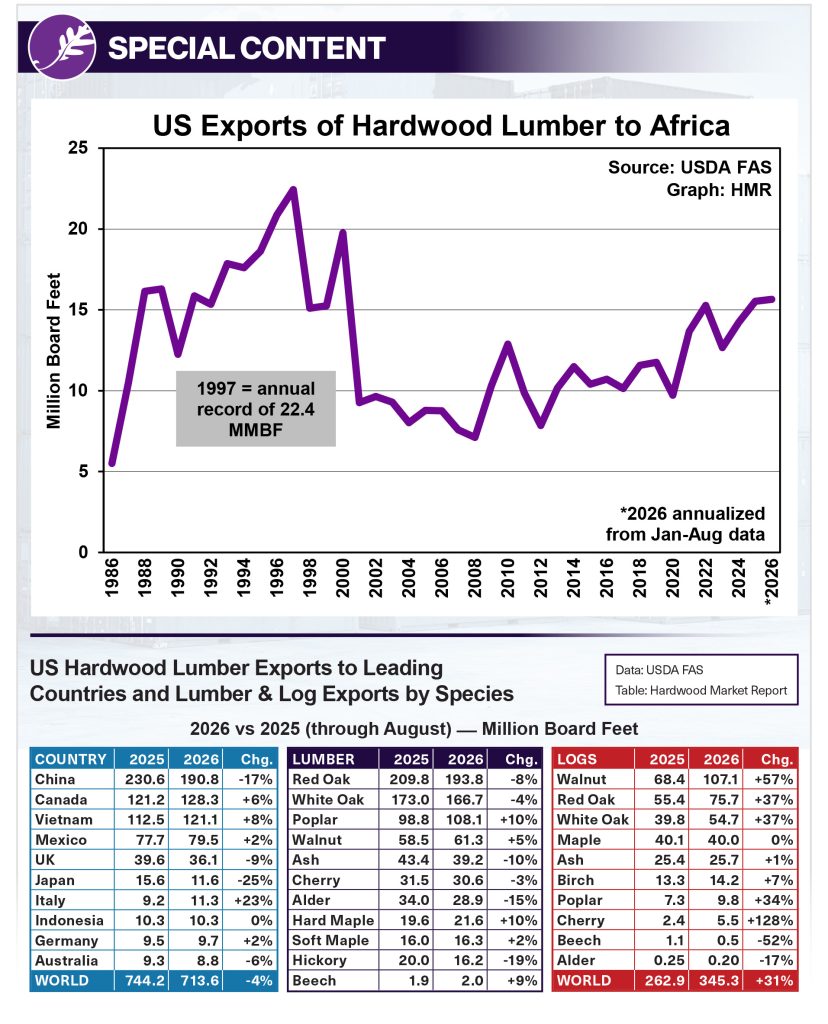
The US Department of Agriculture released its export statistics for the third quarter, which showed that US exports of hardwood lumber totaled 246.7 million board feet (MMBF), down by 9% year over year. The slowdown was mostly caused by lower Red Oak shipments to China, which contacts reported throughout the summer and into the fall. Exports to the Middle East totaled 7.3 MMBF, up by 6% year over year and up from 4.2 MMBF in the second quarter, when volumes were down by 46% year over year due to disruptions caused by the US-Iran war.
ASH: Ash markets are especially firm in Eastern Canada; producers there are generally reporting higher sales prices than their counterparts in the Upper Midwest. This week, no adjustments are warranted for any green or kiln dried figures. Prices have maintained an upward trend throughout 2026, and area market participants believe this will continue in 2027 if this year’s strong demand persists. Ash supply will only get tighter over time due to the spread of the Emerald Ash Borer, which is putting consistent upward pressure on prices.
ASPEN: Aspen markets are mostly balanced between supply and demand, though prices have been a bit softer lately for kiln dried #1C&Btr items. Earlier in November, the kiln dried Fas listings fell slightly, and in this issue, the low ends of the 4/4 #1C ranges edge down. Aspen hasn’t appeared on any producer’s best- or worst-sellers lists in recent weeks, indicating a so-so market for the species. Lack of production is limiting downside price pressure for both green and kiln dried Aspen.
BASSWOOD: Published Northern Basswood prices are unchanged this week following last week’s kiln dried gains for some Fas and #1C items. Comments about kiln dried demand have improved recently, but the species is hardly featured on any surveyed producers’ best-seller lists. Green markets are slower than kiln dried, but limited production is preventing price erosion. Contacts in the Upper Midwest are generally reporting firmer prices than those in Canada, the reverse of current trends in the Ash market.
BIRCH: Producers report steady prices for both Unselected and Sap&Btr Birch, holding all green and kiln dried listings and ranges in place this week. Observed net tally prices for kiln dried Sap&Btr 4/4 Fas Birch are generally in the area of $2,000 per thousand board feet ($/MBF), versus the current Unselected listing of $1,450/MBF. Buyer interest is focused almost entirely on Sap&Btr for Fas and #1C, whereas low-grade Birch is still commonly sold Unselected.
HARD MAPLE: Gains are observed in prices for kiln dried thick-stock #1C Hard Maple this week, lifting both ends of the #1&2 White 6/4 ranges and the low ends of the 8/4 ranges. The #1&2 White 8/4 #1C listings posted their first gains since April last week, indicating that the worm may be turning for #1C, though upward pressure has not been sufficient to lift the 4/4 through 6/4 listings. Prior adjustments have all other Hard Maple figures in order. Comments about demand for the species are mostly lukewarm or negative, though a few sellers note modest improvement.
SOFT MAPLE: All green and kiln dried Soft Maple listings and ranges stand pat this week, as markets for the species have not changed appreciably, nor have reported prices. Kiln dried Fas prices have recently found a bit of stability after sharp declines throughout the summer and early fall lowered those listings to two-and-a-half-year lows. The Sap&Btr 4/4 Fas listings have been unchanged for three weeks, while the 5/4 through 8/4 listings have held steady for four weeks. Northern producers are having a much easier time moving Sap&Btr #1C and #2A Soft Maple than Fas, as has been the case for several months.
RED OAK: After holding steady for two months, the kiln dried 4/4 Fas Red Oak listings and ranges are lowered this week, while the 5/4 Fas listings and low-end ranges extend last week’s losses. Additionally, most kiln dried #1C range numbers are reduced across thicknesses, along with the 5/4 #1C listings. All other listings and ranges, both green and kiln dried, are unchanged. Despite solid domestic demand for Red Oak throughout most of this year, #1C&Btr prices have been under downward pressure since the summer because of a drop-off in exports to China. USDA data show that China imported just 22.0 MMBF of Red Oak lumber from the US in the third quarter, down from 34.2 MMBF in Q2 and 39.4 MMBF in Q3 2025. Anecdotal reports from contacts indicate that this slowdown has continued into the fourth quarter.
WHITE OAK: Market conditions for White Oak have not changed since last week, and all listings and ranges are unmoved in this issue. Green prices seem to have found a floor and are now stabilizing a bit after continual declines from early 2025 up until early autumn of this year. On the dry side, Fas remains the best-moving grade, according to sales contacts. The net tally 4/4 Fas listing is currently at $4,000/MBF, up by $250/MBF from its year-to-date low in June.
PALLET LUMBER, CANTS, TIES, & BOARD ROAD: The listings and ranges for crossties and pallet materials hold firm this week amid consistent reported prices from Northern contacts. Ties and cants have been moving well for producers across regions in recent months, and that is showing no signs of stopping.
Market conditions are steady for board road, and that listing and range also remain intact this week. Supply scarcity is the main source of recent upward price pressure in this sector amid steady demand.
Comments from November 20, 2026.
Residential solid wood flooring plants reported steady to slightly higher production in October, supported by one additional working day than in September. Meanwhile, flooring shipments rose 4.9% in October, according to the HMR/Fastmarkets estimate. The daily pace of shipments barely budged, edging up 0.1%.
Contacts say demand warmed up starting in mid-October, following a lull in September. This did not quell long-term concerns about stagnant new home construction and significant headwinds posed by the prevalence of wood look-alike products. It did, however, ease worries of an earlier-than-usual start to seasonally slower demand that typically begins around Thanksgiving.
The warmup has also resulted in certain flooring plants having larger-than-expected order files for mid-November. For example, one manufacturer has ample orders for Sel&Btr Red Oak and common-grade White Oak. Momentum for Sel&Btr Red Oak has been present most of the year, while interest in common-grade White Oak flooring has gained momentum over the last few months. Plants are working down Sel&Btr White Oak inventories, and observed prices warrant reductions to most Sel&Btr White Oak range figures. Conversely, information lifts the Southern listing and the high-end range for 2¼” No. 2Com Red Oak and the listings for 3¼” No. 1Com White Oak in each region.
Green 4/4 #2A&3A White Oak lumber remains widely available. Excess supply prompted reductions to those listings in the Appalachian region last week. Certain sawmills have reduced White Oak production, attempting to more closely align supply with demand. Meanwhile, reported prices sustain the recent increases to the 4/4 #2A&3A Red Oak listings. Looking ahead, lumber buyers anticipate being able to procure enough White Oak, even as some supplying mills are putting more material into industrial items.
Elevated diesel prices continue to hamper potential flooring shipments and impact trucking options. Full truckloads with no wasted trailer space can help reduce the per-unit shipping cost, making it more economical than less-than-truckload options amid sky-high fuel prices. This, according to a large flooring manufacturer, is the impact: “Shipments are occurring closer to the time flooring is needed for the job, pushing inventory backward in the supply chain.”
October 30, 2026