
Comments
Comments from July 24, 2026.
In another challenging year for American hardwood market participants, the pallet sector has offered a bright spot. Many pallet producers have increased production and sales, with tighter supplies and higher prices for softwood pallet materials helping increase hardwood usage. This has led to an HMR/Fastmarkets estimate that shows hardwood pallet cant and lumber consumption up 11.3% in 2026.
With prices firming recently, Northern and Appalachian sawmills have benefitted, but Southern mills haven’t been as fortunate. In fact, this week, reported prices decrease the cant listing and top side of the range. The downturn in crosstie buying is the central reason for the Southern trend.
Recent years have seen crosstie production become a key output for many Southern sawmills. In 2026, however, railways are not buying ties in the numbers they were last year, which is having an outsized impact on Southern mills that rely more heavily on tie sales than their counterparts in other regions. Also, #2A&3A Oak are more abundant in the South than elsewhere. Consequently, cant production is relatively high in the region, preventing price appreciation.
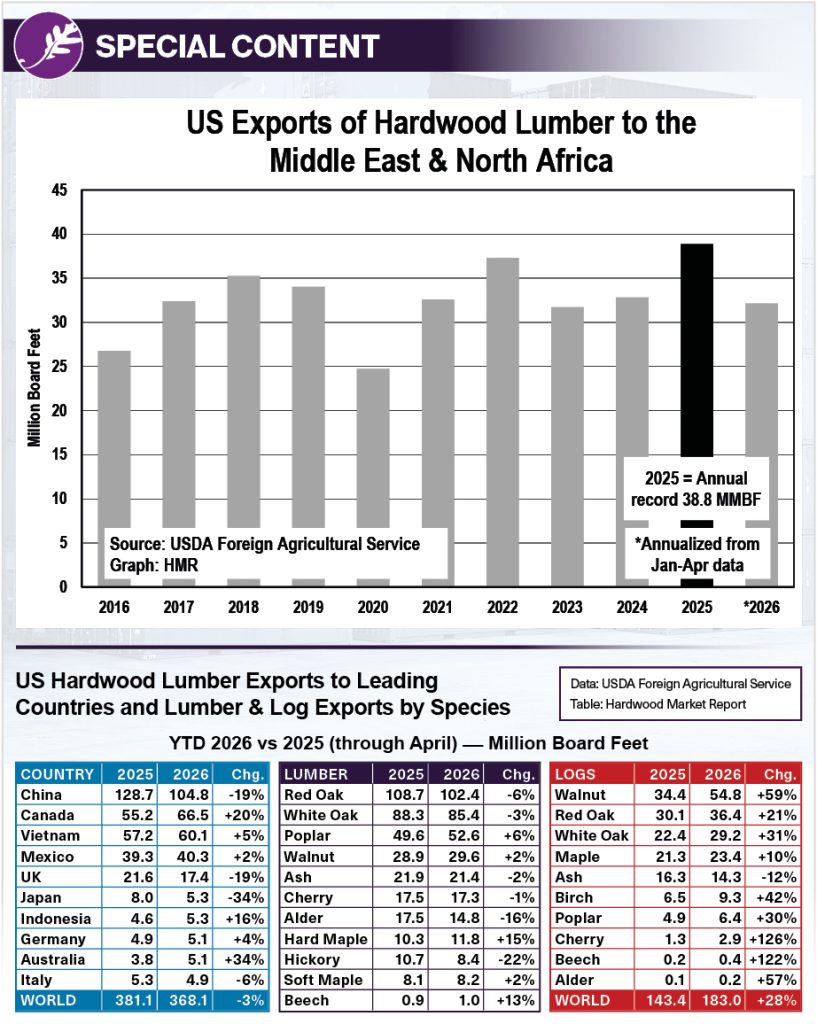
Overall, the Southern hardwood market is relatively slow. Contacts point to increasing freight rates, due to the resumption of the US-Iran war, and a slowdown in lumber purchases from China and Vietnam as causes for concern.
ASH: After several weeks of movement in the green Ash market, activity stabilized this week, with reported prices holding all the listings in place. On the kiln dried side, more Ash entered the market amid steady international demand, resulting in decreases to the 4/4 #1C&Btr listings and low ends of the 4/4 #1C ranges.
SOFT MAPLE: While Soft Maple has limited uses by secondary manufacturers, lack of production has caused green #1C&Btr prices to firm up. Though the 4/4 Fas&1f listings stay stable, information increases the list prices for 5/4 through 8/4 Fas&1f as well as all #1C prices.
#2A&3A OAK: The #2A&3A Oak market remains cool. While truck trailer flooring producers are buying in larger volumes, a slowdown in purchasing by residential flooring plants has balanced it out. Contacts have rarely mentioned #2A&3A Oak when asked about their business of late. Reported prices keep the #2A&3A Red and White Oak listings intact again this week.
RED OAK: There is little energy in the market for green Red Oak, with demand and supply well balanced, and prices unchanged from a week ago. There is more movement for dry stock, however. Reported prices drive decreases to the ranges for 4/4 Fas as well as the listings and ranges for 4/4 #1C. Despite these changes, one contact in Alabama described kiln dried #1C as his best seller. “The demand for #1C is there from Vietnam,” he said.
WHITE OAK: Don’t expect to hear much enthusiasm if you ask a Southern sawmill operator about White Oak these days. The green market remains sluggish, with the lack of interest in Fas&1f particularly striking. Reported prices necessitate decreases to 4/4 and 5/4 in those grades. Kiln dried supply and demand are well balanced. International buyers, especially in China, are seeking out far less White Oak now than at this time last year.
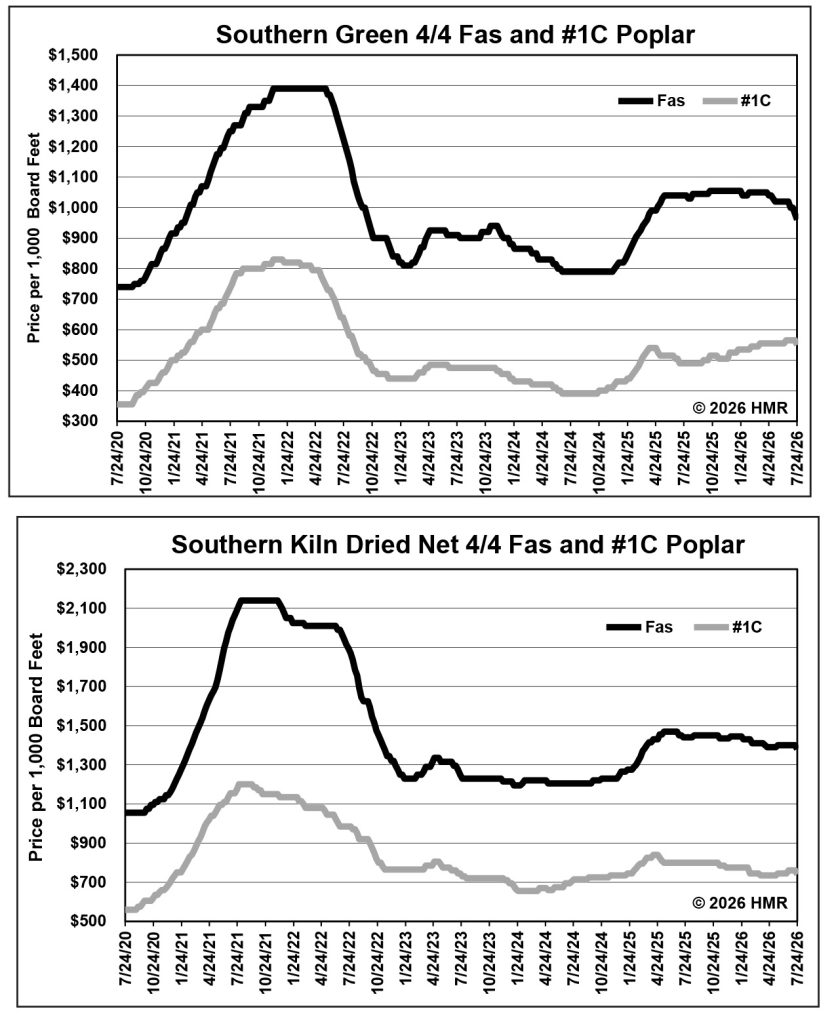
POPLAR: Of all the species in the Southern region, Poplar sees the most price changes in this issue. The green 4/4 and 5/4 Fas&1f listings slip for the second straight week, while #1C also falls for the same thicknesses. On the kiln dried side, reported prices reduce the listings and noted ranges for 4/4 Fas and 4/4 #1C. Cooling Chinese interest is understood to be influencing these price movements.
BOARD ROAD, FRAMESTOCK, CANTS & TIES: Lower demand for crossties and an overabundance of low-grade Oak are keeping cant production elevated and prices soft in the South. The listing and upper end of the range for cants fall in this edition.
After a bump in demand over recent months, there is a decrease to the lower end of the range for Mixed Species framestock this week. The range for Oak framestock stands. Board road and mat timbers continue to perform well in the South; the board road listing and range stand pat.
Crosstie quotas have been in place throughout 2026 and are holding tie purchasing, and prices, steady on both sides of the Mississippi. A longtime area tie treater told HMR/Fastmarkets he is concerned by recent freight increases and how they would impact Southern sawmills enduring an already tough year.
Comments from July 24, 2026
This week’s conversations and survey comments were largely centered on the short- and long-term impacts of recent sawmill closures. Namely, contacts discussed how closures will impact the balance between supply and demand. Given the myriad headwinds the hardwood industry has faced since 2018, supply and demand reaching equilibrium might feel like a watershed moment.
That did not occur this week, however. More published prices fell than rose, and comments suggest stability remains elusive. According to a buyer for one wood products manufacturer, “Supply and demand seem to be in balance despite the low amount of lumber being produced.” However, another buyer said, “Lumber availability is still ample to oversupplied.”
It is too early to determine the overall impact of recent sawmill closures on the market. A long-awaited upcycle might emerge next week, next month, or next year. When capacity attrition does end and demand for hardwood lumber increases, even modestly, producers are concerned the industry might not be able to fully capitalize on the uptick before the next lull occurs.
On a more granular level, all secondary wood products manufacturers responding to surveys over the last three weeks described their lumber inventories as adequate. Meanwhile, reports about finished goods sales vary from sector to sector. Lumber sales are fair to moulding, millwork, and component producers but remain slow to the wood furniture sector. The pallet industry remains the busiest low-grade market.
ASH: The usual market dynamics that apply to other species don’t necessarily apply to Ash because the dwindling resource—caused by the ongoing spread of the Emerald Ash Borer—limits production, helps prevent inventory growth, and supports price floors. Markets for green Ash are busy enough to keep production shipped at prices consistent with the listings. The lone exception is 8/4 #1C, for which reduced prices lower the listing. Conversely, upward momentum is evident in kiln dried 4/4 Fas prices, and the listings advance for a second consecutive week.
BASSWOOD: Basswood supplies are adequate to satisfy limited demand. Producers are shipping all green #2B&Btr and kiln dried #2A&Btr at prices closely aligned to the published figures.
CHERRY: Yards have become less aggressive with green Cherry purchases, responding to slowing Chinese demand. Activity remains weak in other markets, including the US. To better reflect reported prices, the 4/4 #2A and #3A listings are lowered in each subregion. However, information raises the Appalachian green 4/4 #1C listing and kiln dried 5/4 and 6/4 Fas listings.
HICKORY: Arguments can be made that Hickory is the region’s strongest species, in terms of relatively easy sales at steady-to-higher prices. Producers are having no issues selling green output, with sizeable volumes of #3A&Btr moving to residential flooring plants. Green #2A&Btr prices are raised in all thicknesses, but no changes are required to any kiln dried figures.
HARD MAPLE: Demand for this species contracted sharply in spring, coming off a favorable winter. It took a combination of reduced production and discounted prices to bleed off excess inventories, align supply with demand, and stop the downward price trend. That balance continues this week. Appalachian sawmills and yards have not seen improvement or deterioration. Reductions in prior weeks have all the green and kiln dried figures in order.
SOFT MAPLE: Soft Maple has fallen below Hard Maple as the weaker of the two species. Both are among the leading species utilized in wood cabinet manufacturing. However, Soft Maple is typically more prevalent in moulding and millwork applications and in the case goods sector. Despite this diversity, demand for Soft Maple is now slow. Lower reported prices reduce the green 5/4 through 8/4 Fas&1f, 4/4 #1C, and 4/4 #2A listings in each color designation. The Sap&Btr 5/4 through 8/4 #1C listings also retreat. For kiln dried, the listings and noted range figures for 4/4 and 5/4 Fas decline in both color classifications.
#2A&3A OAK: Certain flooring manufacturers report tighter Red Oak availability resulting from sawmill capacity reductions alongside stronger demand for Red Oak than White Oak finished goods. Competition is inching up among residential and truck trailer flooring manufacturers, but not enough to move the #2A&3A Red Oak listings higher. Instead, prices in observed transactions hold all the listings steady for the seventh consecutive week. Lumber inventories at some truck trailer flooring plants are adequate, but others are increasing their #2A&3A White Oak inventory targets. All the White Oak listings carry over from last week, however.
RED OAK: According to a yard contact, “Red Oak still moves, but it is nothing to get excited about.” The comment aligns with Chinese demand for Red Oak losing some steam in July and from the US-Iran war curtailing sales to the Middle East. Supplies of most kiln dried items align with demand, leading to limited price movement. Information reduces the 4/4 #1C listings but raises the high-end ranges for 8/4 Fas. Pressure on kiln dried prices is weighing on green 4/4 Fas&1f prices, as reflected in decreases to the listings.
WHITE OAK: Contacts continue to report two different markets for upper-grade White Oak. One, for 8-foot lengths, is described as “doggish” and includes large price discounts. The other is for 9-foot and longer stock that moves relatively well. Relative to availability, activity is stronger for 5/4 through 8/4 #1C than for 4/4. Limited activity in the kiln dried matrices this week suggests a closer balance between supply and demand. Reports do warrant increases to the low-end ranges for 4/4 Fas, helping tighten what had been a wide range. The high-end ranges for 5/4 #1C and listings for 6/4 #1C also advance. Supplies of green White Oak are readily meeting the market’s needs at prices consistent with the listings.
POPLAR: Markets are struggling to absorb green 4/4 Poplar output. Incoming information shows lower prices that reduce the listings for 4/4 #2A&Btr and 5/4 Fas&1f. Comments about kiln dried Poplar are mixed. Some exporters report no change in demand from Vietnamese furniture manufacturers, but others say those manufacturers are either inquiring about—or are purchasing—larger monthly volumes. No changes are warranted to any kiln dried listings or ranges following declines for certain items in recent weeks.
WALNUT: Market dynamics for Walnut lumber haven’t changed. Demand remains stronger for #1C and #2A than for Fas. Sellers have decent domestic business but slow international sales. Observed green prices warrant reductions to the 4/4 Fas&1f listings but no changes to #1C or #2A. Kiln dried transactions point out relatively stable prices. US exports of Walnut logs climbed 61% year over year through May, with Vietnam and China accounting for 90% of export volume. Total exports are on pace to set a new annual record by a wide margin in 2026.
FRAMESTOCK, CANTS, TIES, & BOARD ROAD: Relatively few Oak and Mixed Species framestock transactions were reported this week. The Mixed Species range holds steady after rising last week. Oak framestock prices are also within the existing range.
Pallet cant production is marginally adequate to meet the market’s needs. While upward price pressure is evident in parts of the region, the listing and range stand pat.
Though a certain mill reported a higher crosstie price this month than last, there is no indication of broadly higher pricing across the region or any change in quotas. Almost all reported prices are holding steady inside the respective subregional ranges.
Board road markets are not particularly strong in the region. Information holds the listing and range in check.
Comments from July 24, 2026.
The most noteworthy trend in the Northern hardwood market at the present time is softness in green Hard Maple prices. Demand for the species is still good, according to contacts, but higher temperatures are spurring producers to move their green production for lower prices in order to prevent potential staining. Hard Maple was one the best-performing species in the North during the spring, far outperforming Appalachian Hard Maple, but those earlier price gains are now being given up.
Similarly, Red Oak prices have also recently come under downward pressure after a solid first half of the year, during which prices routinely increased. Markets for the species seem poised for further losses amid a slowdown in Chinese demand and a likely uptick in production following the lifting of Oak Wilt restrictions in Wisconsin, Michigan, and Minnesota.
ASH: Ash is still moving well for contacts in the Northern region, particularly for export, though recent reports of a slowdown in Chinese demand could stymie this going forward. Tight supplies caused by the Emerald Ash Borer are providing steady upward pressure to prices and limiting any downside. Both green and kiln dried prices have risen gradually since December and are at or near the highest levels in close to four years. All listings and ranges are in order this week following gains in recent issues.
ASPEN: Similar to Ash, limited production is working to limit any downside in the Northern region Aspen market. Contacts report that supplies of the species are tight, especially for Fas items. While no contacts have listed it among their bestsellers in recent weeks, neither have any listed it among their worst-sellers. Those mills that are still cutting the species are consistently receiving inquiries and are able to move it at steady-to-firmer prices. Published prices for both green and kiln dried Aspen have risen gradually since the spring of 2025 and are at the highest levels in roughly three years. Reported green and kiln dried prices are well represented by the respective listings and ranges.
BASSWOOD: The Basswood market remains a mixed bag for producers in the Northern region. One mill operator reported a recent uptick in inquiries for kiln dried 6/4 #1C as well as solid demand for kiln dried 4/4 #1C&Btr and 8/4 items. The same contact said they’re able to move most Basswood items easily, though he attributed this to the fact that they have diverse markets in the US and internationally. Other mills, both in the Upper Midwest and Northeast, have listed the species among their worst-sellers and are struggling to move it. All Basswood listings and range numbers are unchanged this week.
BIRCH: The Birch market is still sluggish in the Northern region. Many mills are avoiding cutting the species because it is either unprofitable or difficult to move. This lack of production is the primary reason Birch prices have not eroded much the last couple of months, as mills are almost universally reporting weak demand. What little interest there is in Birch is mainly centered on Sap&Btr or red color sorts, especially for #1C&Btr lumber. Both green and kiln dried Birch prices have been on a continual downward trend since late 2022 and are at the lowest levels in roughly five-and-a-half years. Prices gathered this week keep all the published green and kiln dried figures intact.
HARD MAPLE: All green Hard Maple listings in both color sorts fall in this edition amid numerous reports of lower prices from contacts in the Northern region. A buyer for one area yard told HMR/Fastmarkets that green producers are having to accept lower prices in order to move Hard Maple loads before they stain due to higher temperatures. Comments about demand for Hard Maple are still mostly positive, however, and it remains a commonly listed bestseller. Even so, markets are now characterized by excess supply, especially on the green side. Kiln dried prices have also come under downward pressure; all 4/4 through 6/4 #1C listings and several #1C range numbers fall this week in both color classifications. Also of note, kiln dried Fas Hard Maple is selling in extremely wide price ranges, especially for thick stock. Producers in the Upper Midwest are fetching higher prices than their counterparts in the Northeast US and Eastern Canada.
SOFT MAPLE: Most Northern region producers are struggling to move Soft Maple. It’s been a commonly listed worst-seller in recent weeks, and market participants are reporting that the species is amply supplied. Consequently, prices for most green and kiln dried items have been trending downward for close to two months. Hard Maple is still comparatively cheaper in the region, and the cabinet sector—which is the primary demand driver for Soft Maple—has mostly been described as “fair” by survey respondents. A sales contact in Michigan told HMR/Fastmarkets that customers are bidding aggressively lower for kiln dried Fas and that demand for #1C and #2A has been slow, with both grades currently selling at a loss. Reported prices lower the 4/4 Fas listings and ranges in both color sorts, along with the Sap&Btr 5/4 Fas figures and low ends of the 4/4 #1C ranges. Meanwhile, higher trading ranges are noted for kiln dried Sap&Btr 5/4 #2A.
RED OAK: The buyer for a kiln drying operation in the Upper Midwest told HMR/Fastmarkets that he has been receiving more calls from green producers, which indicates that Red Oak inventories are building in the region. Overall Red Oak exports have fallen recently, according to contacts, amid a summertime slowdown in Chinese demand. This decrease in a key demand-driver for the species, along with an expected seasonal increase in production, may weigh on Red Oak prices in the near term. Downward pressure is evident for some kiln dried items this week, lowering the 4/4 and 5/4 Fas listings, along with the 4/4 #1C and 5/4 Fas range numbers. However, reported green prices are in line with the current listings, holding them all steady.
WHITE OAK: The market for Northern White Oak is maintaining the same steady-to-softer posture it’s been in since March. The species has been in a state of oversupply since early 2025 amid reduced consumption by the barrel stave sector. Prices have been working to find a floor since, and despite increased forward purchasing of the species in recent months, reported prices still show a downward bias. Producers with lots of 9-foot and longer stock or who are able to provide minimal sapwood are selling their kiln dried Fas loads for prices well above the current HMR listing, but prices for random length loads are still relatively soft. Prior adjustments have all the green and kiln dried listings and ranges in order this week.
PALLET LUMBER, CANTS, TIES, & BOARD ROAD: The market for pallets and cants in the Northern region is maintaining its strength for producers amid a seasonal uptick in demand. Both ends of the cant range are raised this week. The cant listing is up $25 over the past seven weeks.
At least one tie treating operation in the Upper Midwest is issuing more crosstie orders, but most other facilities are maintaining quotas. No changes are warranted to the price range at this point.
Market conditions for board road are unchanged in the region, and the listing and range are flat.
Comments from July 24, 2026.
Since contracting in Q1 2025, US GDP has expanded each quarter since, with the pace varying widely (US Bureau of Economic Analysis). Analysts anticipate that GDP grew one to two percent in Q2 2026, despite the impact of the US-Iran war on oil prices (Federal Reserve Bank of Atlanta). Growth is still growth, even if it lags analyst “expectations.” Inflation slowed 0.4% in June after rising in May, marking the largest monthly decrease since April 2020 (Bureau of Labor Statistics).
Regarding housing, the 21st Century ROAD to Housing Act—aimed at lowering housing costs, improving affordability, and speeding up construction—is now law, with impacts to be determined. Meanwhile, the National Association of Home Builders and Fannie Mae are predicting modest growth in single-family housing starts in 2027, rebounding from the 6.3% contraction on the year through May. The market remains vastly undersupplied, builders continue to report good underlying demand hampered by affordability, and the remodeling sector remains strong.
Mortgage rate forecasts for the second half of this year put rates in the mid-6% range, essentially keeping them steady, according to Fannie Mae and others. Lower rates would help improve affordability, alongside lower home prices, and ignite the tepid housing market. However, there is also value in rate stability: it offers predictability for buyers budgeting monthly payments.
The upshot is that new home construction and remodeling activity—and subsequent demand for floor coverings—are ongoing. That doesn’t guarantee strong sales of domestically produced hardwood flooring amid stiff competition from alternative products and wood flooring imports. However, US imports of hardwood flooring were down 26% year over year through May. Lower flooring imports can indicate a soft flooring market, but it’s likely tariffs and fuel price-related shipping cost increases are playing an outsized role in declining imports.
Oak strip flooring production in the US is adequate for the market’s current needs. Price momentum continues for Southern 2¼” Sel&Btr Red Oak and 3¼” No. 2Com White Oak, albeit at a slow pace. Declines for Sel&Btr White Oak in each width have come from the high-side ranges instead of the listings over the last two weeks.
June 26, 2026